
Everything you need to know to successfully form a tart shell, as well as how to bake it empty or filled
So far, we have seen how to prepare the sucrée (HERE) and brisée (HERE) dough.
To make the perfect tart shell, though, it is not enough to know the right ratio or how prepare the dough properly. You also need to know how to line the tart ring and how to bake your tart. Here you will find a detailed guide that will guarantee success through all stages.
Lining a tart ring & forming a tart shell
First of all you should keep in mind that, due to their high proportion of butter, these doughs are prone to softening, when being manipulated with the hands, especially in a room with high temperature. Therefore, after every stage we should briefly chill the dough so that the shell we are trying to form holds its shape.
After resting and before rolling out the dough, we ‘d better remove it from the fridge and let it soften a little for about 15 min.
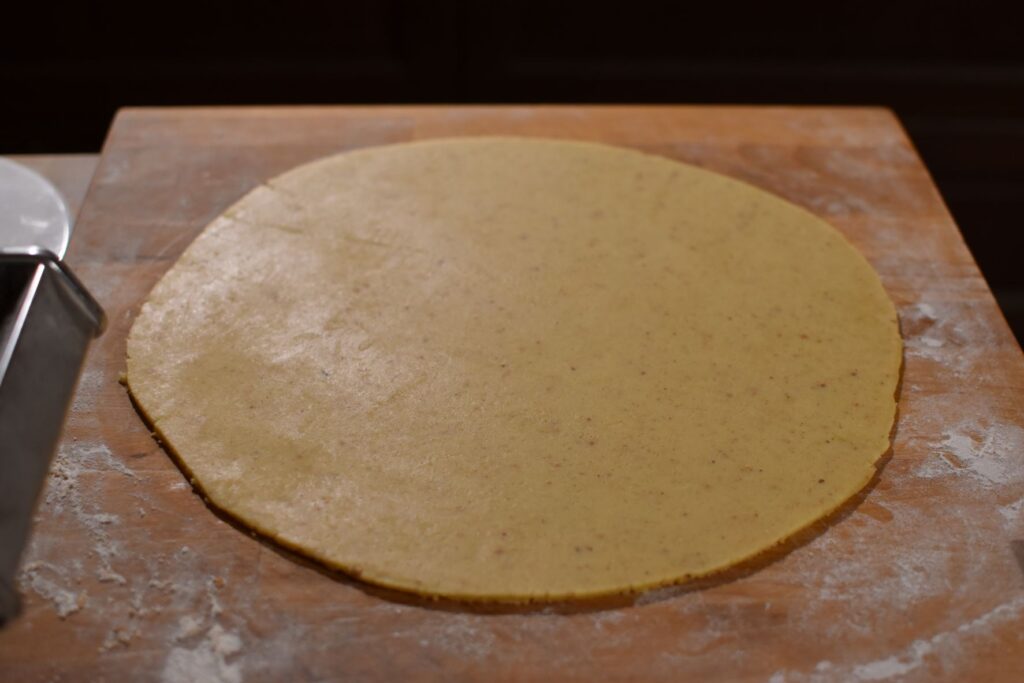
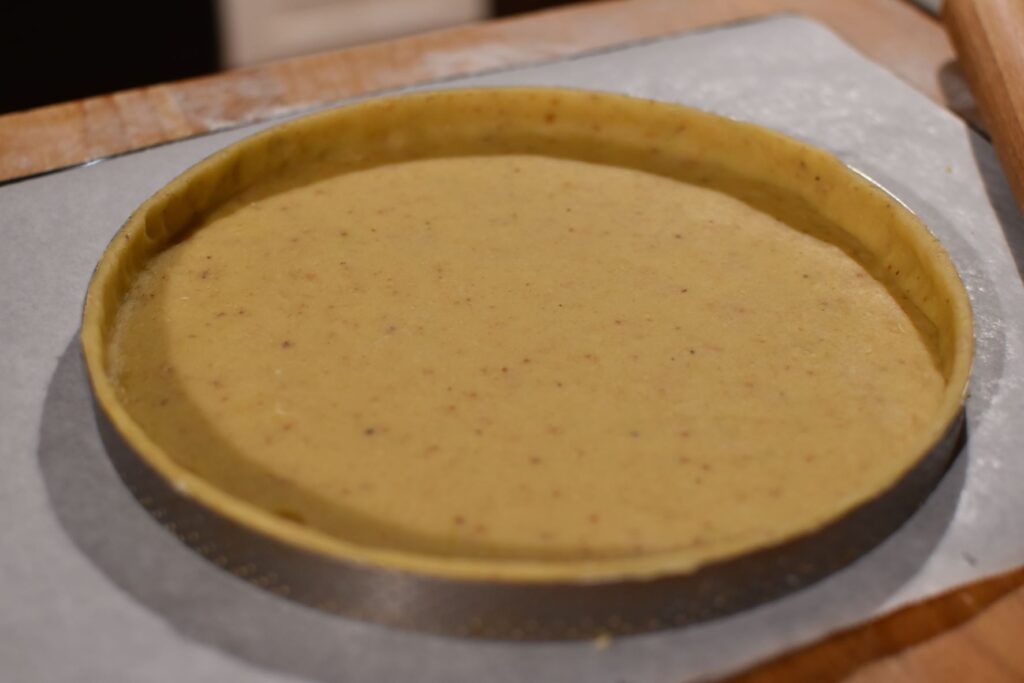
We roll out the dough to a disc of 2-3 mm thickness (or ½ cm for heavier fillings) on a floured working surface or between two sheets of baking paper and return to the fridge for 15 minutes. Then we cut a circle big enough to overlap the sides of the tart ring or tin, roll it carefully around the pin and we line a well buttered tart ring, that we have placed on a baking sheet lined with parchment. If we are lining a tin with a bottom, we should also cut a parchment disk and line the bottom for convenience, unless we use the removable bottom tin.
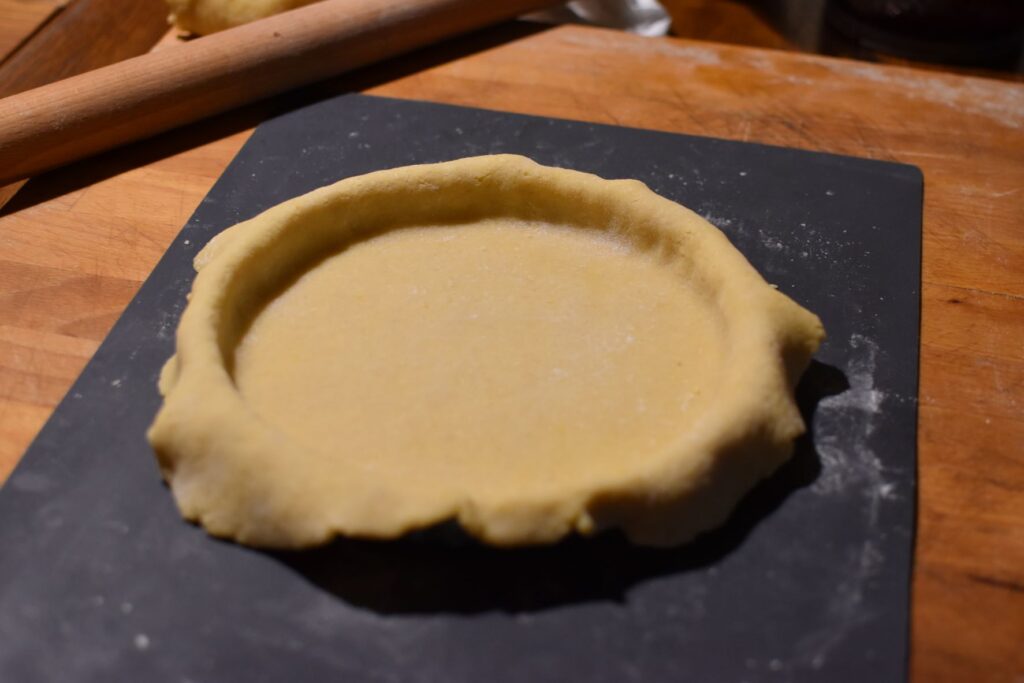
Then with one hand, we lift the edges, while with the other, we lower the dough until a straight angle is created. We press gently with our thumb so that the dough adheres well, making sure not to leave a trace. Finally, we pass the rolling pin over the ring and cut off the excess dough, then return it the fridge for about 10 min to chill again a bit, so that it becomes again firm and retains its shape when cooked.
Baking the tart shell
A tart shell can be either pre-baked, meaning that it is baked empty (this is called blind baking) and then filled, or it can by baked from the beginning with the filling.
I. Blind baking Blind baking is mandatory when we are going to use liquid fillings, as it helps harden the tart shell, before filling it with the liquid, protecting the bottom from becoming soggy. We also choose to blind bake a tart shell, when we are going to fill it with a filling that needs less time to be baked compared to the tart crust, so we partially bake the crust empty, to ensure that the whole tart will be evenly cooked throughout.
Depending on the type of dough we are baking and the mould we use to line it, there are different methods to blind bake a tart crust.
Blind baking a brisée pastry shell The brisée dough due to the high percentage of the contained water, tends to swell easily. So, in order to keep the sides of the pastry shell from collapsing and the bottom from puffing up, we should prick it and fill it with dried legumes, such as beans or chickpeas, which help to evenly distribute the heat of the oven on the base of the crust, while at the same time their weight prevents the swelling of the dough.
Legumes used for blind baking cannot be cooked and eaten, but they can be stored and reused several times in blind cooking. If you do not have any dried legumes to use, you can place a smaller diameter pan on top of the tart shell.
So, after the tart shell has chilled in the fridge, we prick the bottom of the pastry with the tines of a fork, being careful not to go too deep, otherwise we will pierce the bottom and risk the leaking of the filling. Then we line it with parchment paper, covering both the bottom and sides and fill it with beans. We compact them well inside the tart shell, making sure that they reach the edges, so as to spread the oven heat, all over the shell.
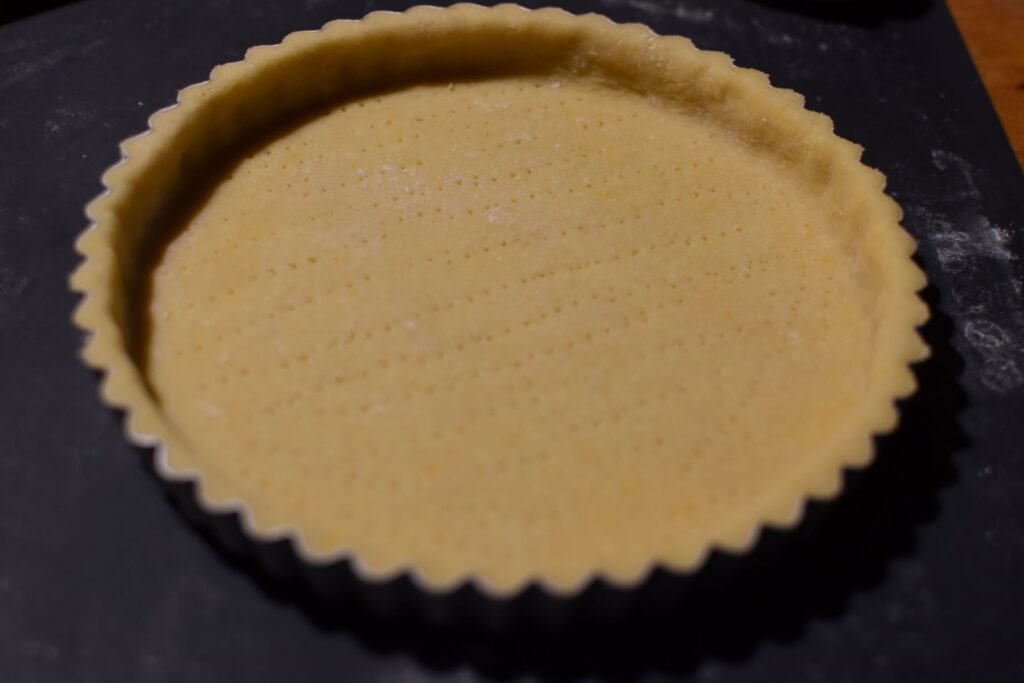
Blind baking a sucrèe pastry shell A sucrée dough (or frolla, as the Italians call it) normally does not need to be pricked or filled with legumes, like brisée, as it does not contain water. If we form the shell correctly, using a ring and placing it on a lined with parchment paper baking sheet (ideally a perforated one, but not mandatory), it should not swell during baking. If we want, though, to prick it, anyway, it won’ t harm (for an extra precaution), but, I repeat, be sure not to prick all the way down, or the cream will run through.
However, if we line the dough in a bottomed tart tin or our lining is not perfect, then it is possible that air bubbles, may form, leading to the swelling of the crust, during baking. Therefore, in this case it is better to bake it pricked or/ and in blind.
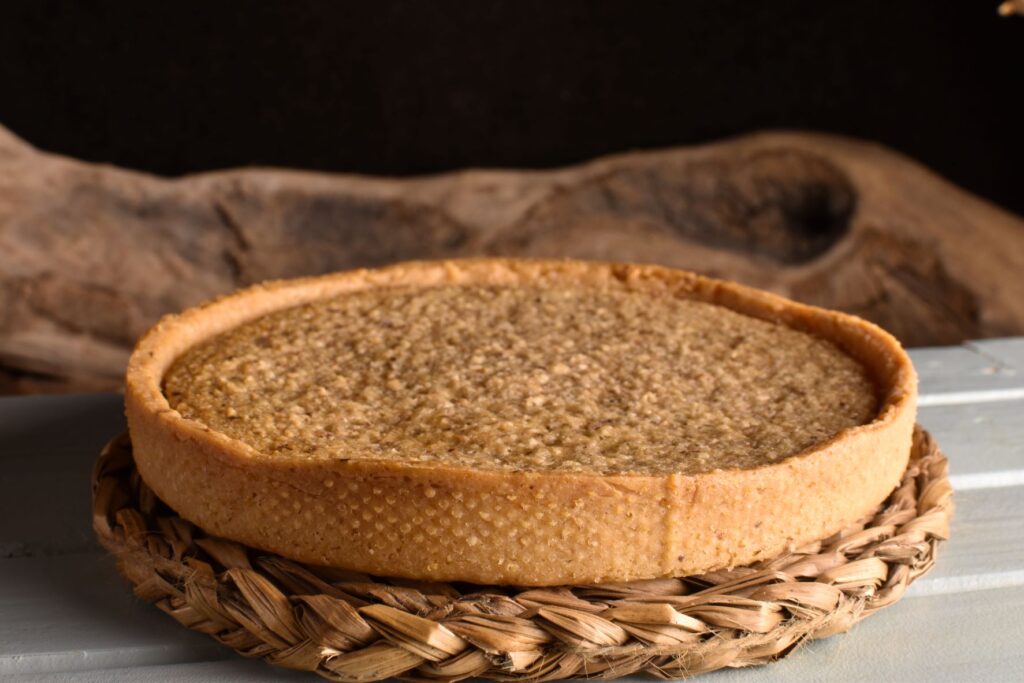
Blind baking temperatures and times As for the blind baking temperatures and times, I have standardized the following guideline, that corresponds to the behavior of my oven. But, as I always say, each oven has its own habits, so you should better adjust the baking, according to your oven.
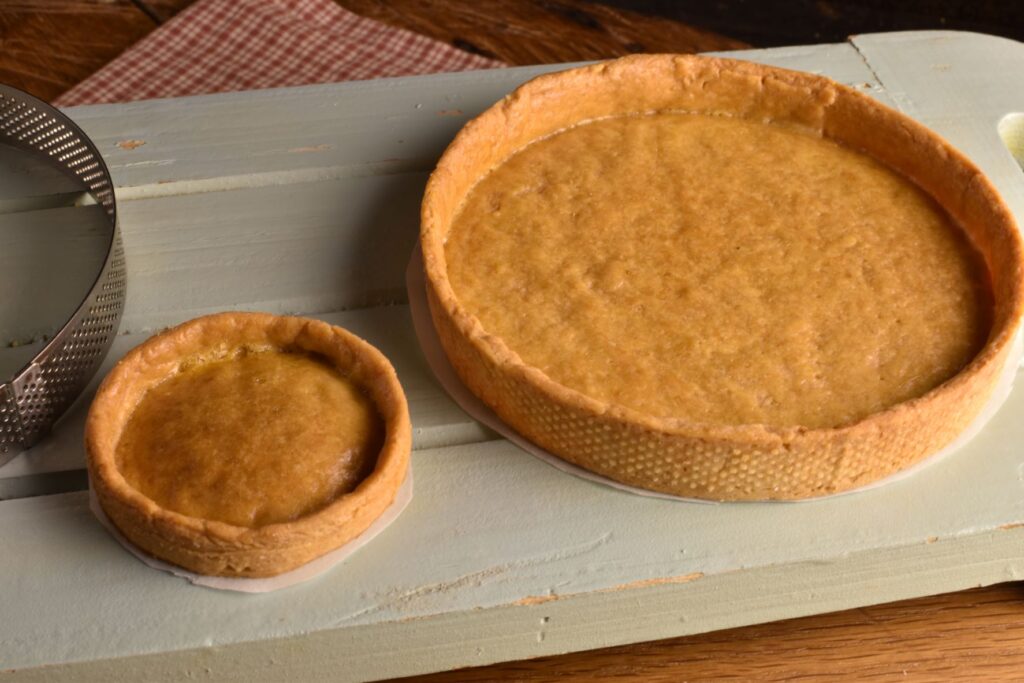
(a) Full baking We preheat the oven to 185-190 ° C – static function and bake for 3 minutes. We lower to 160-155 ° C and continue baking for another 11 min. After that, if we have used legumes, we remove them. We also remove the tart ring (at this point the shell will have shrunk a little and will have been detached from the ring), so that the dough is evenly browned in and out and we continue baking for another 6 min.
To control if the shell has been properly baked, we slightly lift the bottom with the help of a palette, and check its color. It should be evenly golden.
When ready, we remove it from the oven and polish the edges a little with a micro plane or a fine sieve, then brush all over the inner surface a little beaten egg (about 5 gr) and return to the oven for another 2 minutes, so that the egg turns forms a film that will make the shell waterproof and protect it from an eventual sogginess that the adding of the filling would provoke. We then place it on a wire rack and let it cool completely.
(b) Partial baking Sometimes, as already explained, we need to bake the shell alone before adding the filling. We do this mostly when the filling is too heavy and liquid, in which case we need to solidify the shell by prebaking it empty for a brief period. We also do this, when we are going to fill it with a filling that needs less time to be baked compared to the tart crust to ensure that the whole tart will be evenly cooked throughout. In this case, the time of partial blind baking depends on the time that the filling needs to be baked, so we adjust pre-baking time accordingly.
When the partial baking is concluded we place it on a wire rack and let it cool before adding the final filling.
II. Baking with a filling If we are going to bake the shell filled from the beginning (as a flan), we just make sure to prick it with a fork prior to filling it. As for the baking time, normally it needs about 25 minutes, maybe 30 minutes (less for individual tartelettes), but again it depends on what we are baking, so it is better to follow the recipe’s guidelines.
Storage Once cooked, the base of sweet or savory bases can be stored for up to two days before being filled, kept in the fridge.