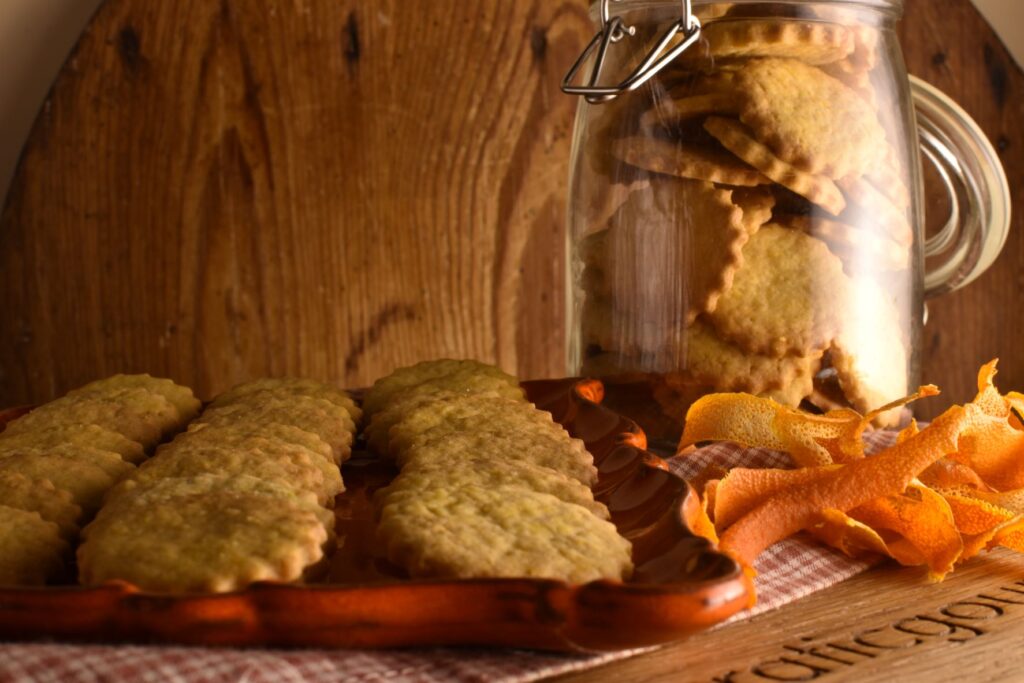

Start making your own citrus fruit powders, both for intense flavor and color!
ingredients for about 80 -100 pieces (total cost about 3,5 € for the whole preparation with organic ingredients)
- 100 g of butter softened
- 75g of brown sugar (here demerara)
- 1 egg
- 250 g of pastry flour
- 2 tsp (6 g) baking power
- 1/2 tsp (1 g) salt
- 2 tbsp (5 g) powdered dried ground orange peel or 1tbsp fresh orange zest
- 1tbsp water (or orange juice if available)
- a pinch of salt
I love to use a bit of citric essence in almost all my pastry preparations. They accentuate and brighten the flavor of most fruits, chocolate and other ingredients. Whenever I am making orange or lemon juice, I always take advantage of the peels. Sometimes, I use them to make candied orange peels (see HERE how I make them), others I keep them in a syrup (see HERE how I used them in my “ricotta mousse with almond crumble, figs and orange rinds in syrup”), while others I dry the peels to add them to my infusions, or to turn them into powder and use them to my sweets, as in this case.
When it comes to doughs and batters, the intense flavor of the powdered zest, remains present for many days keeping them fragrant, until the very last bite. So, to always have it available – even when it is not citrus season or I am simply short of fresh oranges or lemons – here’s what I do.
I finely peel the colored part of the rinds (not the inner white bitter pith) and I dry them out in the dehydrator for about 2-3 hours at 45 o C. If you do not have a dehydrator, spread them on a baking sheet and put them in the oven heated at the lowest temperature (50 o C at most ovens) for a couple of hours.
I let them cool completely and then keep them in glass jars. So, whenever I wish to add a bit of citrus flavor to my cakes, biscuits, pie doughs, creams, or maybe even decorate them by dusting colored citrus powder, I just grab a handful of dried peels, put them in my coffee grinder and turn them in to fine powder. To use them, I sieve the amount I need along with the rest of my dry ingredients. Just be careful not to use too much powder, as it can have a rather strong flavor.
In these biscuits, I have also used demerara sugar, which offers a more caramel flavor and a bit of the beloved mallard effect as well, thanks to the quantity of molasses, that it contains, making them tender inside and crispy outside. Just keep in mind that you should bake the biscuits for less time than you usually do with biscuits made with regular sugar.
So, first of all we cream the already softened butter, by beating it in the stand mixer for a few minutes, then we add the sugar and continue to mix, until well incorporated.
We lightly whisk the egg, slowly add it to the the butter mixture – one tsp at a time, and continue mixing, until fully absorbed. It might curdle a bit, but that won’ t be a problem. We dilute the salt to the liquid we use (water or juice) and add it to the mixture as well.
We add the flour, baking powder and powdered orange peel, by sieving them on top of the mixture in a few batches, until absorbed. If you are going to use fresh orange zest, instead of powder, it is better to add it from the beginning along with the butter, since fat helps the oil perfumes of the zest come out.
We transfer to a well floured working surface, and knead for a few minutes, until a soft but stable dough is formed. We cut in two, we shape two balls, cover with cling film, and keep in the fridge for about an hour to let the dough stand.
We take the dough out of the fridge, we let it soften a bit and then we roll out each ball in a very well floured working surface to about a 3mm thickness. We transfer again for 10-15 min to the fridge to re-harden it a bit, in order to help the biscuits hold their shape, then we cut out biscuits using a decorative pastry cutter and we arrange them on baking sheets covered with paper parchment.
We bake at a preheated oven (175o C – static function) for 7-8 min or until biscuits are settled and just lightly golden. Keep in mind that they should still be soft to touch. They will become more hard once cooled. We transfer them on a wire rack.
When completely cold we keep them in a glass jar or wrap them with plastic to ensure that they maintain their crispiness.