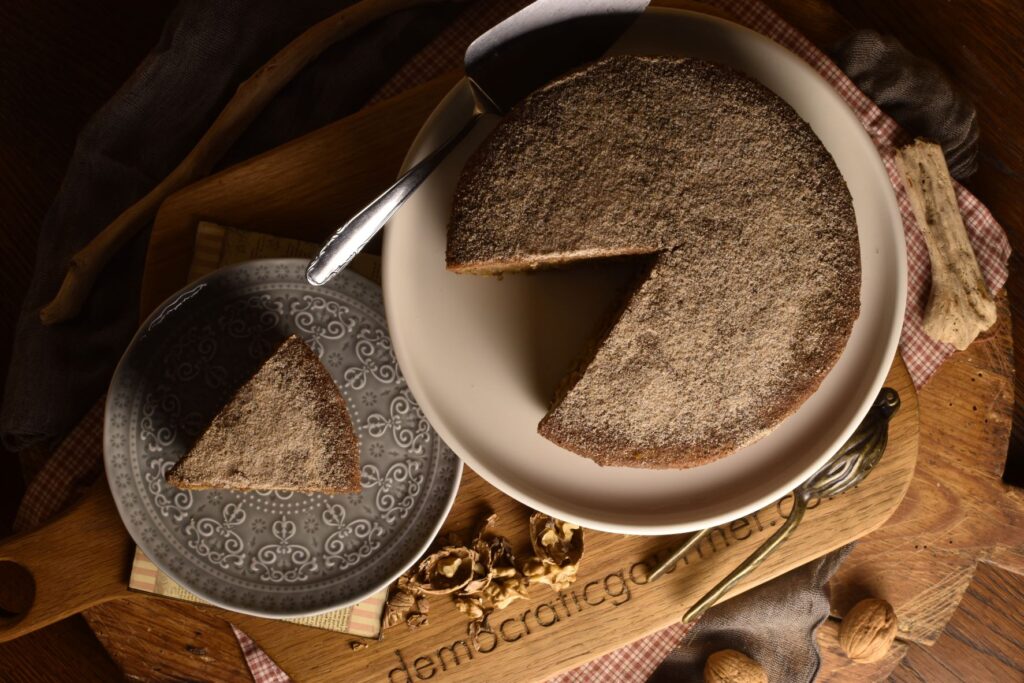

Listen to the advice of Tselementes and add currants to your cakes and other sweet preparations
ingredients for 8 generous servings (cost about 8€ with organic products)
- 65 g butter
- 20 g mild EV olive oil or sunflower oil
- 150 g superfine sugar
- 3 large eggs
- 225 g pastry flour
- 10 g baking powder
- 1,5 g baking soda
- 70 ml orange juice
- 100 ml milk
- 75 g walnuts toasted and coarsely chopped
- zest from 3 oranges
- 50 g black currants
- 5 g cinnamon
- 2 g salt
- superfine or icing sugar for dusting, mixed with a little cinnamon
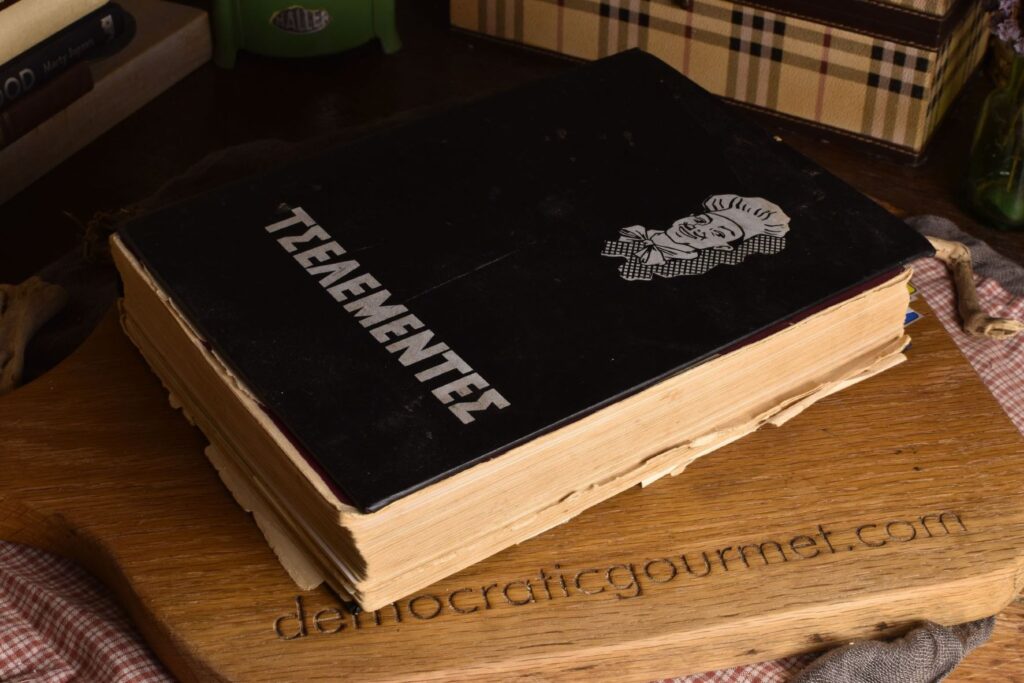
I am very proud to own a hard copy of the legendary “Cooking and Patisserie Guide”, written and published in 1930 by Nikolaos Tselementes, the Greek Escofier, whose name is up to this day in Greece a synonym of the word “cook book”.
In his book Tselementes had dedicated a whole chapter to sweets (cakes and other pastries) based on currants and raisins.
In the preface of this chapter he had mentioned, characteristically that he considered them one of the most exquisite and beneficial products of our country and he encouraged the readers to use them more often in their various sweet and savory preparations.
Who am I to disagree? Indeed, ever since I first read his book, I started using currants and raisins to my cakes and other confectioneries and, soon, I realized, how they add complexity and elevate their texture and flavor. What is more, as currants are already very sweet, we can lower the amount of added sugar in our preparations.
In this cake, I chose to use the Corinthian variety of currants. They are black, small, sweet, juicy, incredibly tasty and super nutrient. They are, actually, considered a superfood. I just tell you that they are packed with vitamins A and B, iron, potassium, selenium, catechin, oleic acid, minerals, polyphenols and many fibers.
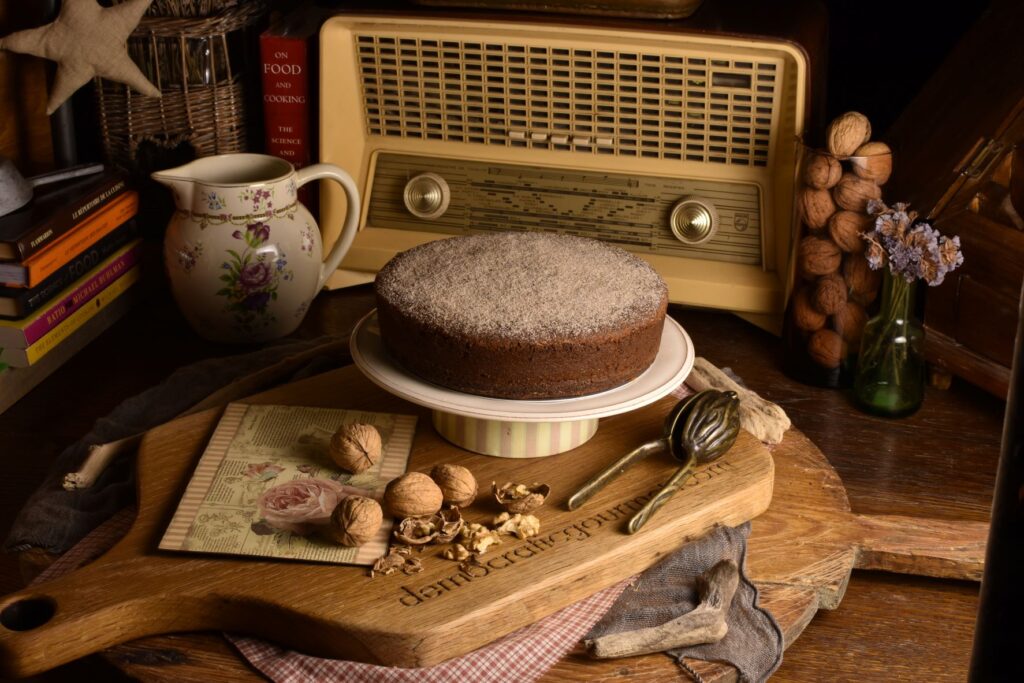
I paired them with walnuts and orange for a classic, successful combination.
So, first of all, we place the currants in a bowl, we add enough warm water to cover them completely and we let them soak for about 20 minutes. The we strain them very well, we dry them well with kitchen paper and we keep them aside. We also toast the walnuts for about 5-8 minutes at 120 o C. When cool, we coarsely chop them.
To prepare the cake batter we lightly whisk the eggs (along with a pinch of salt), the milk and the orange juice. We melt the butter and we mix it with the oil.
In the mixer bowl, we sift the flour together with the baking powder, baking soda, cinnamon, sugar and the orange zest. We mix them briefly to combine, we pour in the melted butter and oil and half of the egg / milk / juice mixture and we beat at low speed, until the solids are wet, then we raise the speed and we beat for another minute just to aerate the mixture. We add the remaining liquid mixture in two batches, beating for about 30 seconds each time to incorporate them well into the mixture.
We pour 1/3 of the batter into a well buttered, lined with parchment, re-buttered and floured 20 cm round cake tin. We spread half of the chopped walnuts and half of the currants on top at equal distances. We repeat, pouring the second 1/3 of the batter and spreading on top the remaining walnuts and currants. We finish by pouring the last 1/3 of the cake batter. We hit the cake tin on the counter a few times to release trapped air pockets and to leaven the batter.
We bake it in a preheated static oven at 160 o C for about 45 minutes.
We remove the cake from the oven and after 5-10 minutes we unmold it and we immediately wrap it well with cling film in order to retain its moisture and softness. We let it cool completely, as it is wrapped. Once the cake has cooled completely, we generously sprinkle it with superfine or icing sugar, mixed with a little ground cinnamon.