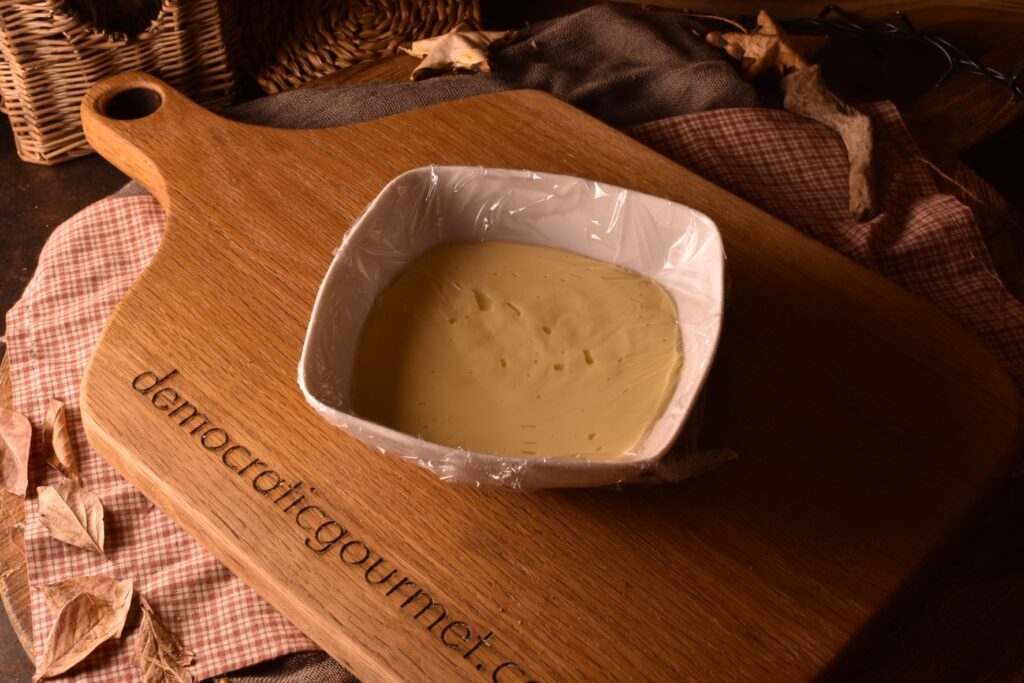

The mother of dessert sauces!
ingredients for a portion made with 1 litre of milk (total cost about 6,5 € for the whole preparation with organic ingredients)
- 1 litre milk
- rind from 1 organic lemon and/ or other aromatics
- 10 egg yolks (1 yolk per 100 ml milk)
- 100 g sugar (10%)
- a pinch of salt
Crème anglaise is none other than a pastry cream, without the use of a thickening agent (starch or flour), therefore a more fluid one, ideal to accompany desserts, poached fruit etc. We ‘d say that it is actually a sauce, rather than a cream. It is also normally the base to make ice creams.
Since it does not contain starch we use a little more yolks (1 for every 100 ml milk instead of 1 for every 125 ml milk that we use in pastry cream), to enrich it’s thickness.
When making crème anglaise, as with any custard and curd, we have to beat the yolks (or eggs) with the sugar from before cooking them. This is because sugar raises (delays) the coagulation point of the yolk (sugar actually delays the coagulation of both yolks and whites), therefore helps the cream bind before the unwanted curdling occurs.
So, let’ see what we have to do.
Before starting to make the cream, we place a ceramic bowl in the refrigerator and we let it chill well.
In a heavy-bottomed saucepan, we boil a little water for 5 minutes and then we discard it. We do so to protect milk from burning in the bottom of the pan. Then, in the same saucepan, we bring the milk just before the boiling point, together with the aromatics that we use. We can use citrus fruit peels, vanilla, herbs (fresh or dried), spices etc. We turn off the heat, we cover with cling film, or with a lid and we let it infuse for about 30 minutes.
Meanwhile, in heatproof bowl, we gently beat the yolks with a pinch of salt, adding the sugar after a little while in a steady stream and continuing to beat, until they become pale white and we obtain a smooth, creamy consistency. We should not stop stirring at all, while the yolks are in contact with the sugar, because otherwise they will “cook” and the cream will turn lumpy.
We then incorporate the warm milk – after straining the aromatics – little by little in the beaten eggs, stirring constantly. We place our bowl over a double boiler (bain marie) filled half way up with hot water (the bottom of the bowl should not touch the water) and we let it cook over medium heat, stirring constantly, until it starts to thicken. If you use a thermometer, keep in mind that the cream is ready, as soon as it reaches about 85 o C.
When the cream starts to thicken and we see blisters bursting on the surface, we remove the bowl from the bain-marie, we transfer its content to the bowl we have chilled in the fridge passing it through a fine sieve, to eliminate eventual lumps and we continue whisking, in order to lower its temperature and stop the cooking procedure. This way we ensure a shiny look, a silky texture, and total absence of lumps.
Keep in mind that the gentle cooking will guarantee a smooth, velvety cream. If it is cooked in a high heat of for too long, it might curdle. If this happens, in order to “save” it, beat it for a few seconds with an immersion blender, than pass it again through a sieve. This should fix it.
We cover with cling film in contact and keep in the refrigerator to chill, until the time to use it.
The crème anglaise can be stored in the fridge for about 24 hours. Then it should be kept in the freezer for up to a month, though its consistency after defrosting, will not be as good as before.