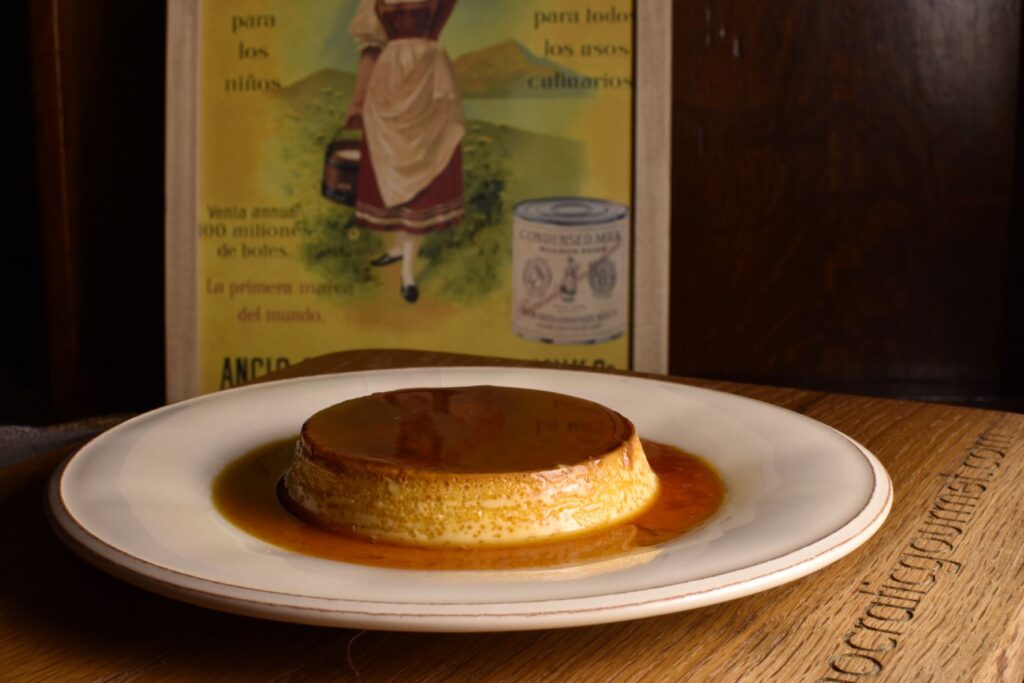

The iconic dessert of our childhood!
ingredients for 8 individual ramekins of 160 ml capacity (total cost about 7 € pp with organic ingredients)
for the custard
- 1 lt milk
- 6 whole eggs
- 85-100 g sugar (according to taste, I like it less sweet than normal)
- peels from 2 oranges, 1 sanguine orange and 1 lemon
- 1/3 vanilla bean
- a pinch of salt
for the caramel sauce
- 200 g superfine sugar
- 90 ml sanguine orange juice (or orange juice, or water)
- 10 ml lemon juice
Crème caramel is a rather simple dessert based on a flavored milk-egg custard, topped with thick caramel sauce. Yet, as we always say in DG, the simpler a preparation, the harder it is to get it perfect. A perfect crème caramel, should have a silky texture, therefore it needs to be gently cooked.
To ensure a gentle cooking, the crème caramel is normally baked inside a water bath. It is actually the gentle heat of the water that cooks the custard.
But, if that is the case, why do we have to use the oven? In my opinion it is a total waste of energy to cook a dessert that does not need baking inside the oven.
If you have a gas stove burner, as I do, it is better to make the crème caramel there. It will be equally well cooked, maybe even better, because the procedure is more easily controlled and adjusted at any point, if necessary.
One last thing. As I say about all milk desserts, use high quality milk, as it is the basic ingredient of the crème. Avoid the ultra processed ones.
So, we begin to make our crème caramel by the milk infusion.
In a saucepan we gently heat the milk with the aromatics and the sugar. Before it reaches the boiling point, we remove from the heat and we let it infuse covered with cling film for about 30 minutes.
To make the caramel, we pour in a heavy bottomed saucepan the sanguine orange juice (or water), the sugar and the lemon juice and we bring to a full boil over high heat without stirring, until we get a rather dark amber color and the characteristic caramel smell.
We immediately divide the caramel equally into the ramekins, working quickly, because after a while the caramel will become unpourable.
In a large bowl we lightly whisk the eggs. We strain the milk and we add it to the eggs in a slow, steady stream, whisking constantly. We filter the custard through a fine sieve.
We arrange the ramekins in the pot or baking dish we are going to use for the water bath, we fill them with the custard and then we fill the pot/ baking dish with boiling water, until 2/3 the height of the ramekins. If we want the cream surface to remain silky and not to brown and form a skin, we can cover the baking dish with aluminum foil. Be sure, thought to place the foil loosely so that the steam can escape, otherwise waterdrops will cover the top of the creams and they will become watery.
If we choose to cook the custards on the stove, we place a jar lid or a small heat proof dish underneath each ramekin, to make sure that they do not touch the bottom of the pot. We place the pot on the smaller burner available, adjusted at low heat. It should take 45-60 min for the custards to be ready, depending on the burner and the size of the ramekins used.
During cooking, the water should never come to simmering point, otherwise the cream will become grainy. If this happens, just add a little cold water (or even better an ice cube) to regulate the temperature or simply remove the pot from the burner for a few minutes.
If we prefer to make the custards in the oven, we place the baking pan on the lowest part of a preheated static oven at 170 degrees and we bake for 30-35 minutes. Again, the water should never simmer.
The crème caramel is ready when the custard surface has just set, being firm to the touch. Do not overcook.
We remove the ramekins from the water bath and we let them cool completely. We then cover them with cling film and we keep them in the fridge to chill for at least 2-3 hours, before serving.
To unmold, we run a small palette knife between custard and the circumference of each ramekin and we turn over a serving dish, letting the caramel sauce be poured over.