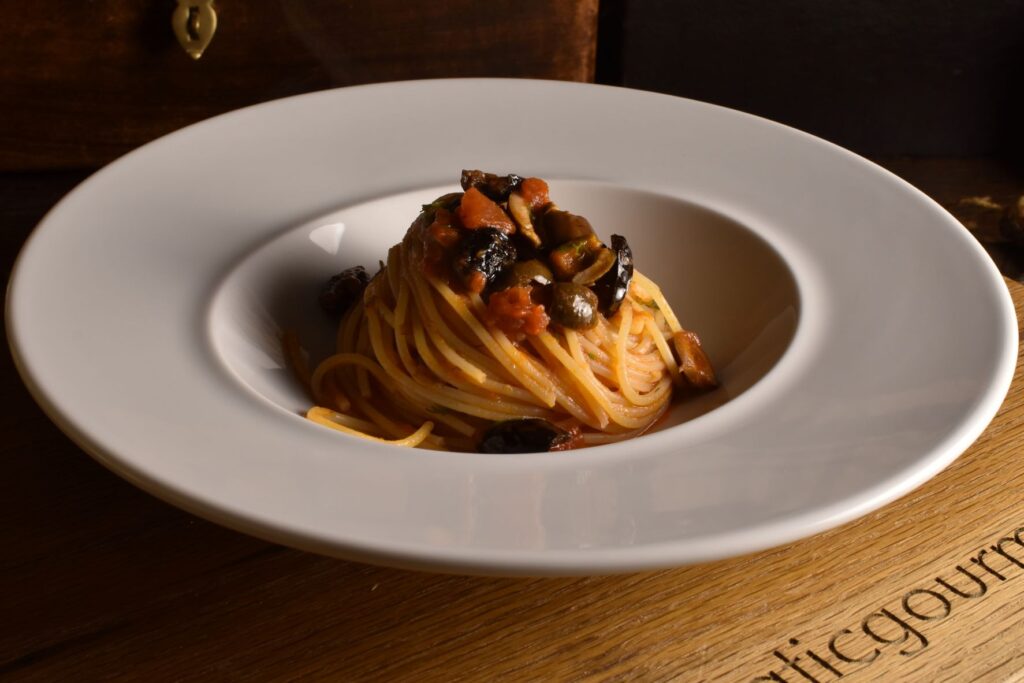
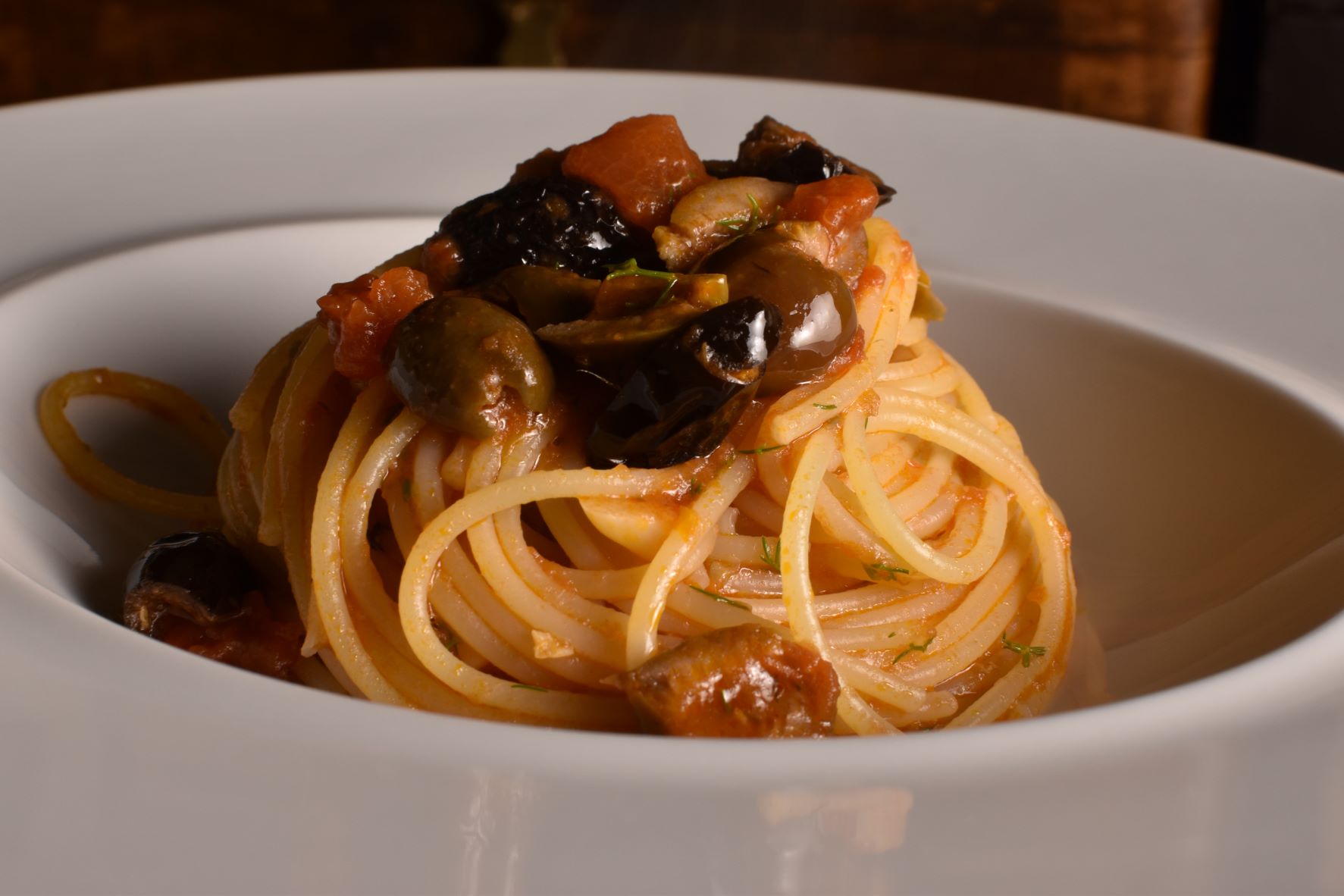
Napoli is a thousand colours
ingredients for 4 servings (cost about 1,5 € pp)
- salt
- 50 ml olive oil
- 6 to 8 anchovies
- 320 g spaghetti or spaghettoni
- 10 small to medium size black olives
- 10 small to medium size green olives
- 15 g capers
- 1 spring onion
- 2 large garlic cloves
- 1 whole can of tomatoes (400g) + the liquid part of another one
- 1 peperoncino
- fresh dill
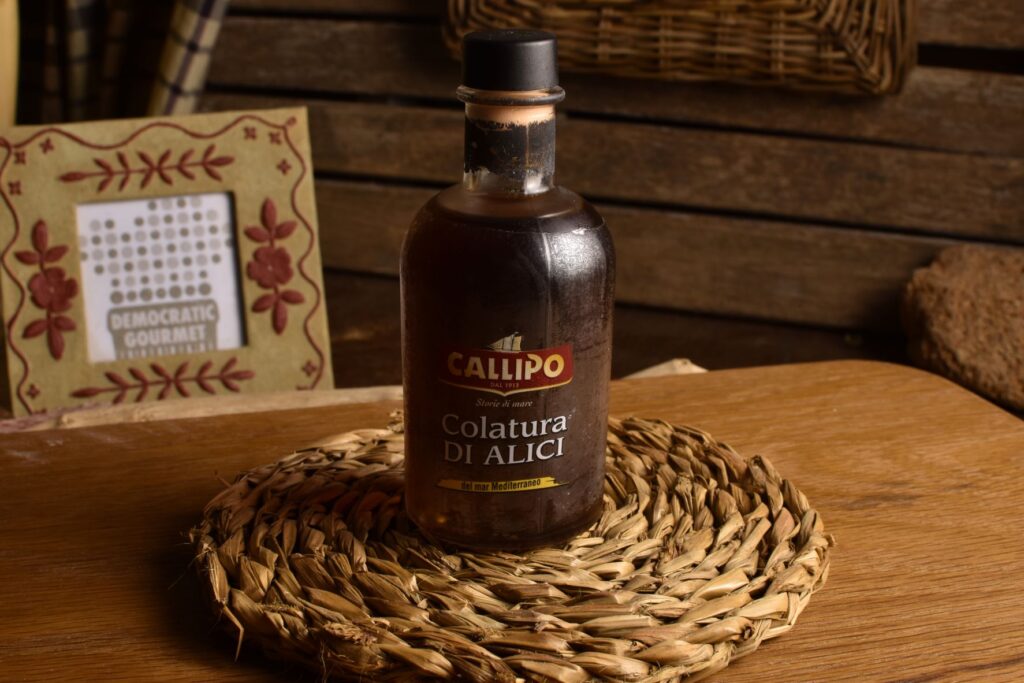
- 4 tsp of Colatura di Alici (optional)
Napoli, autumn 19??
I had just arrived in the magnificent city of southern Italy to study law and on one of my first walks, I was about to eat in a trattoria. When the card arrived, my eyes immediately felt on the strange name of a dish, which until then I didn’t know. “Spaghetti alla puttanesca” was the name and I immediately thought what every young man’s mind would do. So I decided to order it.
“Formaggio?” I asked the waiter with my then awful Italian pronouncing, asking him to bring me some grated cheese. I then thought that grated cheese is a must for every pasta dish!!!!
“Formà, ma che formà”, he answered me, laughing ironically and without giving me further explanations, he turned his back on me.
“What is this asshole laughing about?” I thought. But seeing a colourful and fragrant dish, I decided not to insist on my demand. I was already hungry like a wolf so I erased the cheese from my mind.
I will never forget the first bite. Accustomed to the overcooked and poorly made pasta of Greek cuisine, I expected something similar. I was initially surprised, considering the pasta raw but from the second bite and then I started to like it. Some moments later I felt the whole Italian southern beauty concentrated on a pasta fork.
From what I learned later Puttanesca name (or “spaghetti c’ aulive e chiapparell” in local Neapolitan dialect) had no etymological relation to what I initially imagined, however since then they are an irreplaceable part of my weekly diet.
The puttanesca in its classic Neapolitan version, is made with garlic, olive oil, anchovies, tomato sauce, crushed capers and olives and at the end a little bit of parsley.
During all these years I have made hundreds of versions but I will not tire you with my experiments, I will just tell you the changes I think they make this classic dish, a little bit better, without changing its character
a) I add a small spring onion, cut in 1 cm pieces. I cook it very well and I incorporate in the sauce. I also cut the garlics in relatively large pieces (each clove in 6). I find the alternation of garlic-spring onion-garlic extraordinary.
b) I use two kind of olives, black and green ones. Not only for visual reasons. I also think that the slightly different aroma of black and green olives makes the dish even more interesting. But attention, olives quality is crucial for this dish. DO NOT ever TRY industrial pre-pitted olives. Search for small organic and “tender” olives for your puttanesca sauce.
c) I use dill instead of parsley. Dill is aromatically a better pairing for fishy sauces. The puttanesca sauce is an anchovy based one, so parsley is good but dill is even better. But beware. The dill (or the parsley) quantity must be limited, minimal. I would generally advise you not to add a lot of herbs to your pasta dishes. Do not cover all the other ingredients with herbs. You must just search for a result adds an equilibrated fragrance to your dish.
d) I elevate even more the fishy aromas and the umami of the dish, adding AT THE END colatura di alici. The colatura is an Italian top quality anxovy sauce, which is always used at the end of cooking. If you can’t find it, DO NOT USE low quality industrial fish sauces, they will destroy your dish.
Let’s start. First of all we have to put olives and capers in plenty water in order to reduce their acidity. We do NOT pit the olives, nor mince the capers before. We leave them at least for an hour, better more.
In a cold wok we add the olive oil and the garlic pieces. We bring to heat and we gently fry till pale. We remove (but we keep) the solid parts of garlic. We add the pieces of spring onion and we gently cook them using very low to low temperature. We remove them too.
We add the anchovies and the minced pepperoncino. With a ladle we start melting the anchovies in order to turn them to a pulp. We mince the capers and we add them along with a teaspoon of water, the already cooked garlic and the spring onion in the wok. We continue for a minute or two.
We add the tomato, we stir and we add some salt. We cook the tomato sauce for about 15 minutes.
Meanwhile we bring to boil plenty of salted water and we pit and cut in halves the olives.
When the water reaches to boiling point we add the pasta and we boil it for 1 minute less than the written on package al dente time. We also add the olives in the sauce.
We drain the spaghetti and we add them in the wok along with the minced dill and the colatura de alici. We start stirring and adding a little bit of boiling water.
After about 2 minutes we check the consistency and the saltiness and we serve.