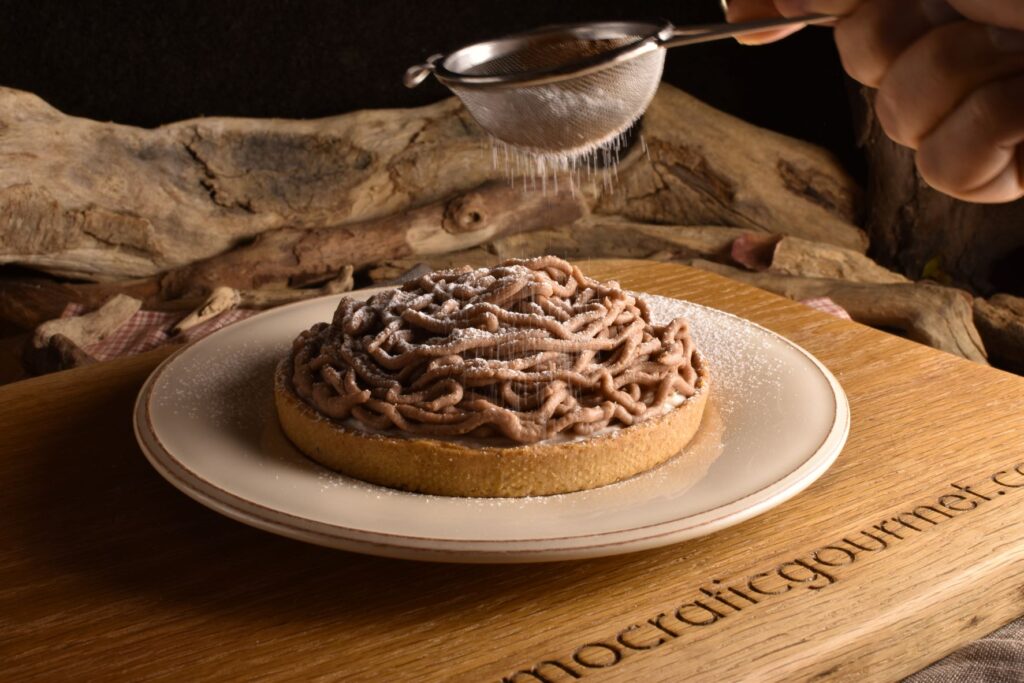
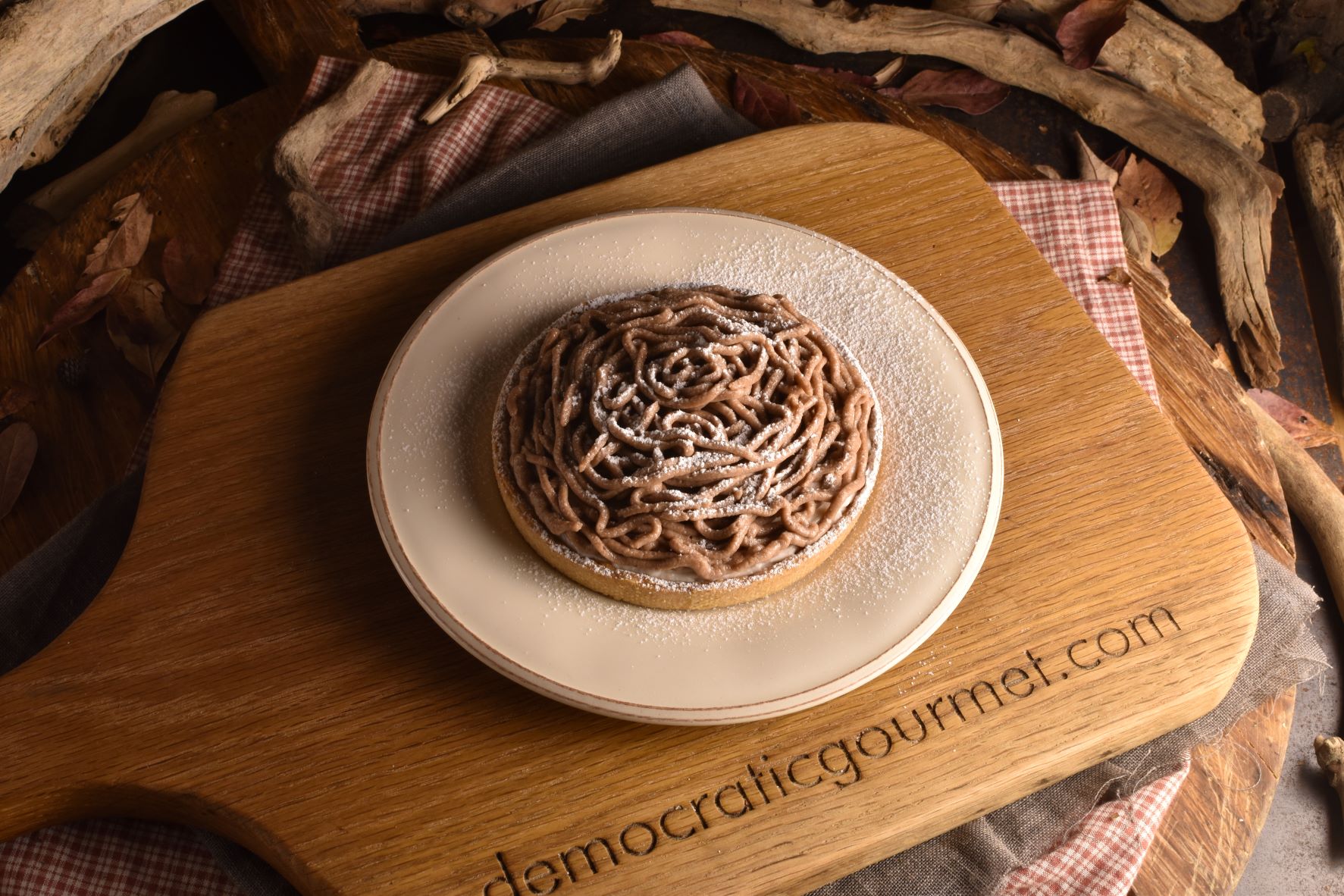
An impressive winter chestnut tart, that can be made a la minute! The only problem to solve is who will pull the chestnuts out of the fire …
ingredients for a 16cm diameter tart (total cost about 5,5€ with organic ingredients)
a portion of our basic sucrèe dough for tarts made with
- 62,5 g pastry flour
- 37,5 g butter
- 18,75 g superfine sugar
- zest from ¼ lemon
- 12,5 g egg (1/4)
- 0,5 g salt
- 10 g ground almond
for the chestnut -ricotta mousse
- 125 g sweetened chestnut puree
- 250 g di ricotta ben scolata
- 30 g icing sugar (or more according to taste)
for the chestnut vermicelli
- 200 g sweetened chestnut puree
- 5 g powdered cocoa (2,5%)
- un pizzico di sale
Yesterday, I was expecting a couple of friends for dinner, so I needed to make a dessert. Having already enough prepared chestnut puree resting in my fridge as well as a little ricotta cheese, I made with it a chestnut – ricotta mousse and a vermicelli topping. I also baked a tart shell with a portion of our sucrèe dough (I always keep some in the freezer) and kept everything in the fridge. After we finished our dinner, I brought everything to the table and assembled in front of our guests a tart version of the iconic Mont-blanc Italian dessert (Actually, I made 2 of them. My name is not Ebenezer). It was a big hit!
The chestnut mousse is really delicious and it can be used either as a filling for cakes, tarts etc., or to make desserts like tiramisu, trifle, or other simple glass desserts. It can be made either with double cream or with cream cheese, such as mascarpone or ricotta. I, personally prefer the ricotta version, as I generally like it more as an ingredient. What is more, it is much lighter in terms of fat, compared to both double cream and mascarpone.
As for the vermicelli topping, it is none other than a chestnut puree thickened (and darkened, as far as its color is concerned) with the addition of a little cocoa powder and passed though an appropriate nozzle to form a pattern reminiscent of the vermicelli pasta.
So, to make our tart, we begin by preparing a portion of our “basic sucrèe (sweet short crust) dough for tarts” (see how to make it QUI) using the amounts of ingredients given here. After the prepared dough has chilled in the fridge, we roll it out to a 3 mm disc and line a 16 cm tart ring, previously well buttered (to find out how to perfectly line and form a tart shell, consult our detailed guide “lining & baking tart shells” QUI). We keep in the fridge.
While the tart shell is resting in the fridge, we prepare the chestnut mousse and the vermicelli, both of which are based on a chestnut puree. So we begin by making the puree (see QUI how). We will need a total of about 325 g.
We keep 125 g of the made puree to chill in the fridge, and with the remaining 200 g we make the vermicelli. We sieve on top of the puree the cocoa powder and stir with a spatula to combine. The cocoa powder helps the puree become a little more stiff, which will help us to properly form the vermicelli, while in the same time it alternates a little the color and flavor of the puree and differentiates it from the mousse, offering complexity to the final dessert. We taste to control the sweetness and, if necessary, we add a little icing sugar. We transfer the cocoa puree into a pastry bag with a vermicelli nozzle attached and keep in the fridge, so that the puree hardens and becomes compact enough in order form the vermicelli.
To make the mousse we need to mix 2 parts ricotta cheese with 1 part chestnut puree. First we strain the ricotta, we pass it 1-2 times through a sieve, as always, and beat it to turn it to a cream. Then we gradually add the chestnut puree, spoonful per spoonful, and mix gently to fully incorporated. We finally, add the sugar by sieving it over the cream little by little, and mixing to incorporate, until we reach the desired sweetness. We keep it in the fridge until the time we assemble the tart.
While mousse and vermicelli are chilling in the fridge, we proceed to a full blind baking of our tart shell, the way explained in our detailed guide “lining & baking tart shells”. Just consult the chapter“Blind baking a sucrèe pastry shell” and follow the guidelines for“fool baking”. Once ready, we let the tart shell cool completely.
As already explained, we can prepare everything in advance – even the previous day – and proceed to the assembling of the tart the last moment. Nevertheless, I would not suggest this, if you are making the tart during a hot day, or in a warm environment, because everything (mousse, vermicelli, icing sugar) will melt and it will turn to a disaster, rather than a success. In such, case it is better to make it in advance and serve it only after it has been well chilled.
To assemble the tart, we just have to fill the shell with the chilled mousse. The mousse should exceed a little the rim of the shell. We level it with the help of a palette knife forming a kind of hemisphere, then we completely cover it with a layer of vermicelli, poaching the puree straight from the pastry bag over our dessert. Finally, we generously dust the tart with icing sugar.